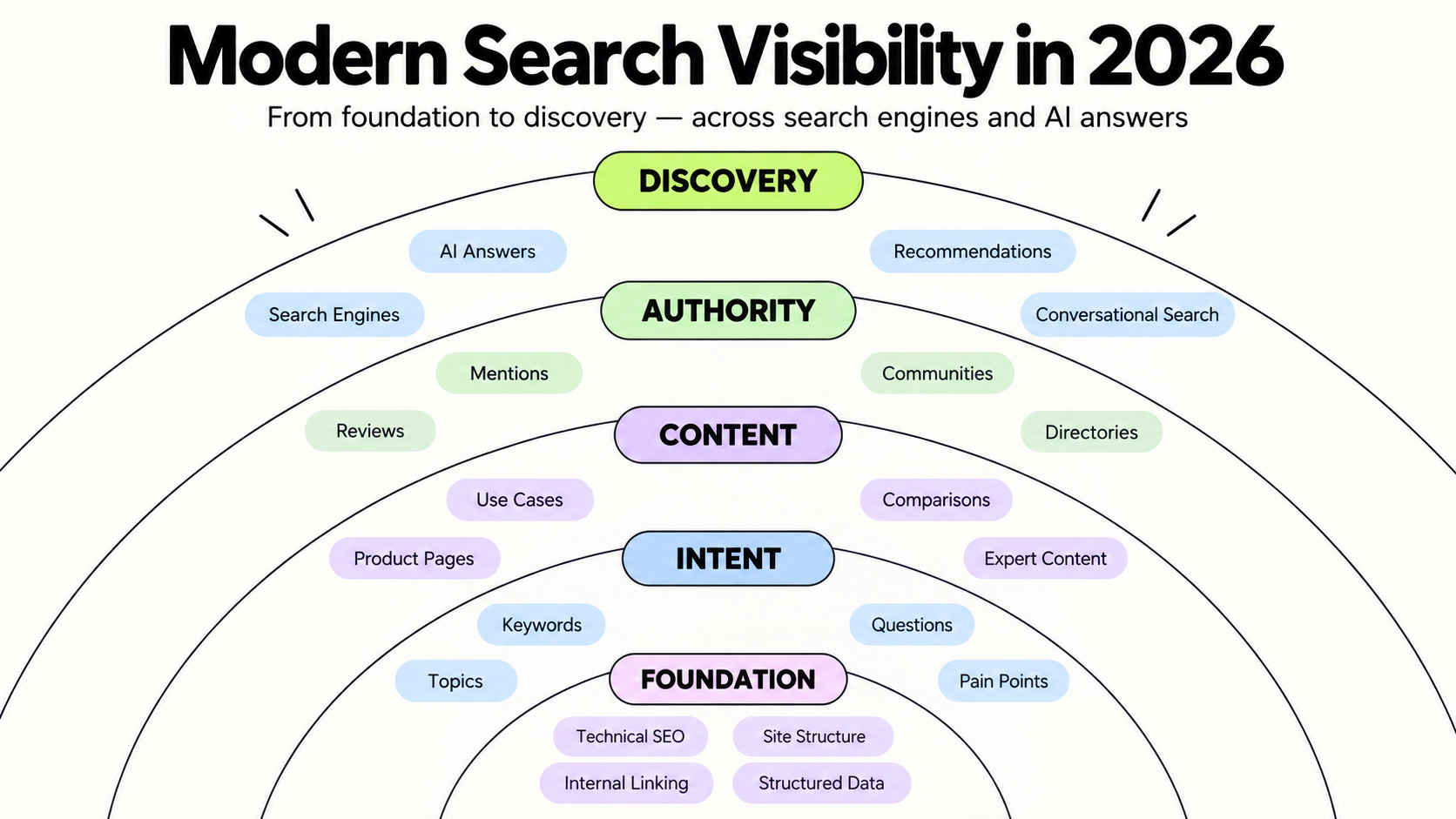
For years, search strategy could be summarized with a familiar objective: create a useful page, earn authority, and rank for the query. That model still matters, but it no longer describes the full path from question to decision.
A buyer may begin with a search engine, read an AI-generated summary, ask a follow-up in a chatbot, open a comparison page, scan a community discussion, and return later through a branded query. Discovery is becoming a system of surfaces rather than a single results page.
Ranking is one outcome inside a larger system
Traditional rankings remain valuable because they create direct traffic and often supply the pages that other systems retrieve. The mistake is assuming that a high position automatically produces visibility everywhere else.
AI answers may cite a different source than the top organic result. Comparison queries may be dominated by publishers or marketplaces. Community discussions may shape the language buyers use before they ever reach a website. Each surface has distinct evidence and trust patterns.
The strategy therefore has to connect owned content with the wider information environment.
Map the surfaces around a buying decision
Start with decisions, not keywords. For one product category, document the questions a buyer asks while moving from awareness to evaluation and selection.
Then map where each question is likely to be answered:
- Search results for explicit demand and known problems.
- AI answers for synthesis and follow-up questions.
- Review and comparison pages for tradeoffs.
- Forums, communities, and social platforms for experience signals.
- Product documentation for precise capability and policy questions.
- Analyst, partner, and media sources for external validation.
This map exposes gaps that a conventional content calendar may miss. A brand can have many articles and still be absent from the sources that shape evaluation.
Build a technical foundation that machines can use
Discovery systems cannot reliably retrieve what they cannot access or interpret. Crawlability, stable URLs, canonical signals, fast rendering, descriptive titles, internal linking, and structured data are still basic infrastructure.
But machine readability is more than schema. Pages should identify the subject clearly, state claims close to supporting evidence, use consistent names for products and entities, and separate current facts from opinion.
Important information hidden in images, scripts, or vague marketing language is harder for both readers and retrieval systems to use.
Make evidence easy to extract and verify
Citation-ready content is specific. It answers a narrow question, shows where the answer came from, and acknowledges limits.
Useful page elements include concise definitions, comparison criteria, methodology, publication and update dates, author or reviewer information, primary-source links, and tables that use consistent dimensions. These elements help a reader evaluate the page and make individual passages easier to retrieve without losing context.
Avoid creating isolated “AI bait” facts. The surrounding page still needs depth, coherence, and a reason for the claim to exist.
Own the comparison layer
Many high-intent journeys are comparative: product A versus product B, alternatives to a familiar tool, the best option for a particular constraint, or whether a category is worth the cost.
Brands often avoid this layer because comparison requires admitting tradeoffs. That creates an information vacuum filled by affiliates, aggregators, and user discussions.
A credible comparison does not need to declare the brand the winner. It should define criteria, state who each option suits, explain where evidence is incomplete, and update as products change. Honest boundaries can be a stronger trust signal than universal superiority.
Authority is distributed beyond the domain
Search and AI systems learn about a brand from more than its own pages. Consistent descriptions across reputable profiles, expert contributions, customer documentation, partner pages, independent reviews, public research, and community discussions all influence the information graph around the entity.
This is not a reason to manufacture mentions. It is a reason to create work that other sources can reference: original research, transparent methodologies, useful datasets, strong documentation, and expert explanations.
Earned authority is difficult to automate because it depends on contribution and trust.
Measure discovery as a portfolio
Rank tracking cannot show the entire system. Build a representative set of buyer questions and review them across search, AI answers, comparison pages, and community sources.
Track whether the brand appears, how it is described, which pages are cited, which competing sources recur, and whether visibility reaches the correct audience. Combine those observations with branded search growth, referral quality, assisted conversions, demo or sales-call language, and conventional organic performance.
Do not reduce AI visibility to a single percentage. The sample of prompts, location, account context, and model can all change the result. Directional patterns are more useful than false precision.
What to do next
Choose one valuable customer decision and build its discovery map. Audit the technical foundation, the best owned answer, the comparison layer, and the external sources that currently shape the topic. Then select one gap in each layer for the next 90 days.
The goal is not to rename SEO. It is to make the brand discoverable wherever buyers assemble an answer.