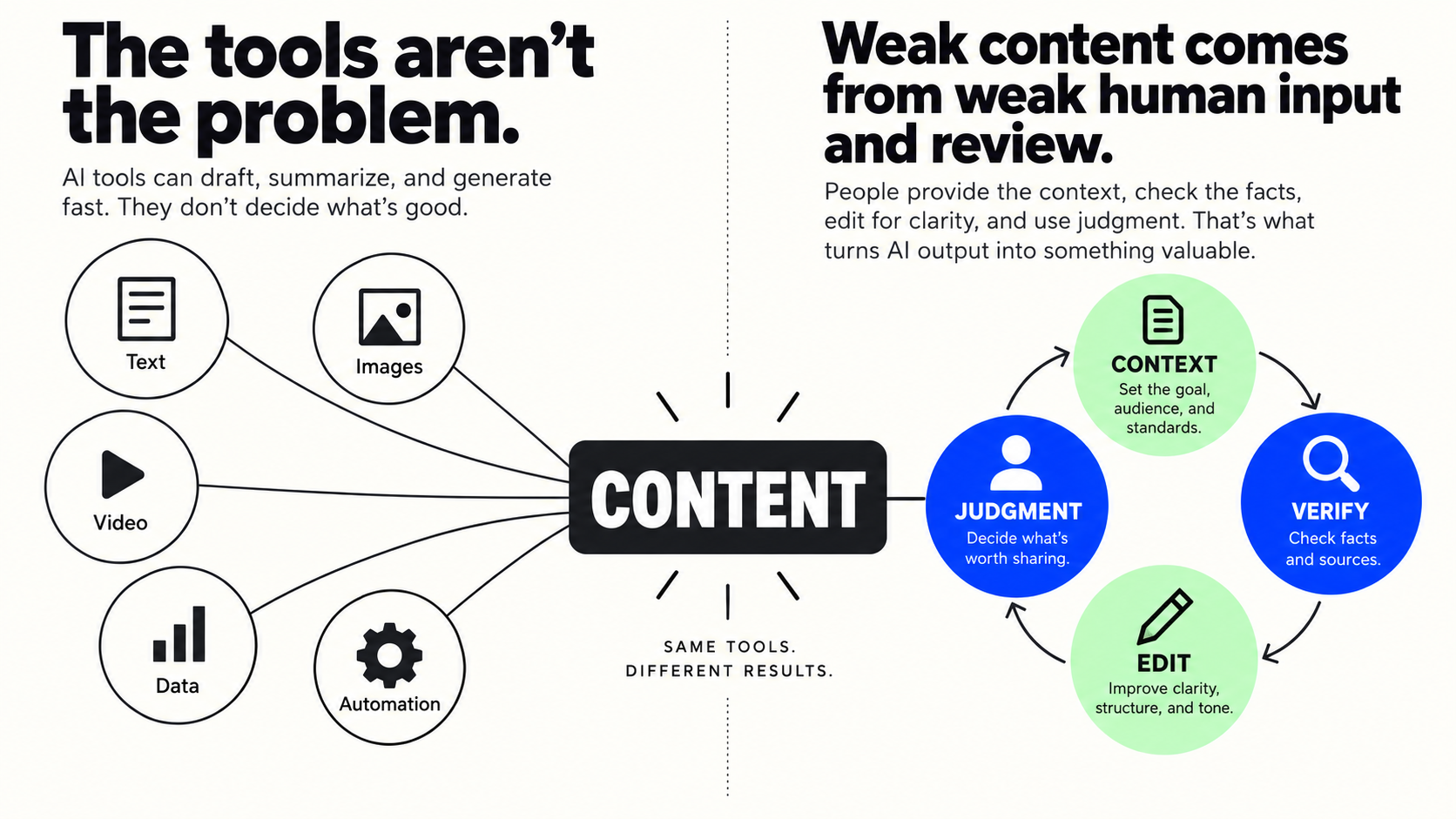
The phrase “AI slop” describes a real problem: a flood of polished-looking material that says little, repeats familiar patterns, and creates more work for the reader than value. But treating the model as the sole cause hides the operational choices that allow weak material to reach publication.
AI can produce text quickly. It cannot decide whether the text deserves an audience. That remains an editorial responsibility.
The visible symptoms begin upstream
Low-quality AI-assisted content tends to share a few symptoms: interchangeable openings, vague claims, unsupported certainty, repetitive structure, predictable lists, and examples that could apply to any company. Those problems often appear in the draft, but they begin in the request.
If the model receives no real audience context, no evidence, no original experience, and no clear editorial position, the safest response is a generic average of familiar material. Changing the model may make that average more fluent. It does not make it more useful.
The production system has to supply what the model cannot infer.
Gate one: prove the piece has a reason to exist
Before drafting, write one sentence that explains the information advantage. What can this piece contribute that a competent reader cannot get from the first page of search results?
The advantage might be original data, direct experience, a tested workflow, access to a practitioner, a comparison across sources, or a clear synthesis of a confusing topic. If the team cannot name the advantage, generation should pause.
This gate prevents speed from becoming the only justification for publication.
Gate two: give the model real context
Useful context is not a paragraph asking for an expert tone. It includes the reader’s situation, the decision they face, what they already know, the evidence available, the claims that remain uncertain, and the organization’s actual point of view.
Context should also contain negative constraints. Identify common clichés, claims that must not be made, and conclusions the evidence does not support. These boundaries are often more valuable than another page of style instructions.
Gate three: separate claims from prose
Fluent prose can make an unsupported statement feel authoritative. For any consequential article, maintain a claim ledger: the material assertions, the source for each, and whether the source directly supports the wording.
The ledger does not need to be visible to readers. It gives the editor a way to audit the draft without relying on how confident it sounds. Claims without support should be removed, narrowed, or labeled as analysis.
This is especially important for product comparisons, health or financial topics, benchmarks, and statements about what “most companies” do.
Gate four: edit for specificity and consequence
A strong edit asks more than whether the grammar is correct.
- Does the opening identify a real tension or decision?
- Does every section advance the argument?
- Are abstract recommendations translated into observable actions?
- Could the examples belong only to this piece?
- Is uncertainty represented honestly?
- What should the reader do differently after reading?
Delete paragraphs that merely restate the heading. Replace broad adjectives with evidence or remove them. Vary the structure when the familiar “problem, five tips, conclusion” format adds no value.
Gate five: restore a human point of view
Point of view does not mean forced controversy. It means making judgments: what matters most, which tradeoff is acceptable, where a popular approach breaks, and what the evidence cannot yet tell us.
The editor should add experience and interpretation that were not available to the model. That may include a failed attempt, a counterexample, a decision rule, or a limitation discovered in practice.
If nobody on the team is willing to own the conclusion, the piece is not ready.
Use a publication rubric
A simple rubric makes quality less dependent on mood. Score each draft on five dimensions: originality of contribution, evidence quality, reader relevance, specificity, and editorial voice. Require a minimum score and make one person accountable for the final decision.
The rubric should be strict enough to reject material. If every draft passes, it is a checklist rather than a gate.
Track corrections, reader complaints, engagement from the intended audience, and whether the content produces the decision or action it was designed to support. Volume alone is not an editorial metric.
Efficiency comes from fewer weak drafts
Human review is sometimes framed as the expensive part of AI content. In practice, the expensive part is producing large amounts of low-value material, sending it through multiple reviewers, and eventually damaging trust.
Better briefs and earlier gates reduce downstream editing. AI can still accelerate research organization, outline exploration, transformation between formats, and first-pass drafting. The benefit appears when the team uses the saved time for judgment—not when it removes judgment from the process.
What to do next
Choose one recently published AI-assisted piece and audit it with the five gates. Identify where generic material entered the workflow and which gate would have caught it earliest. Then add that gate to the next brief before anyone generates a draft.
The objective is not to prove that AI content can be good. It is to build a system in which low-value work has fewer opportunities to escape.