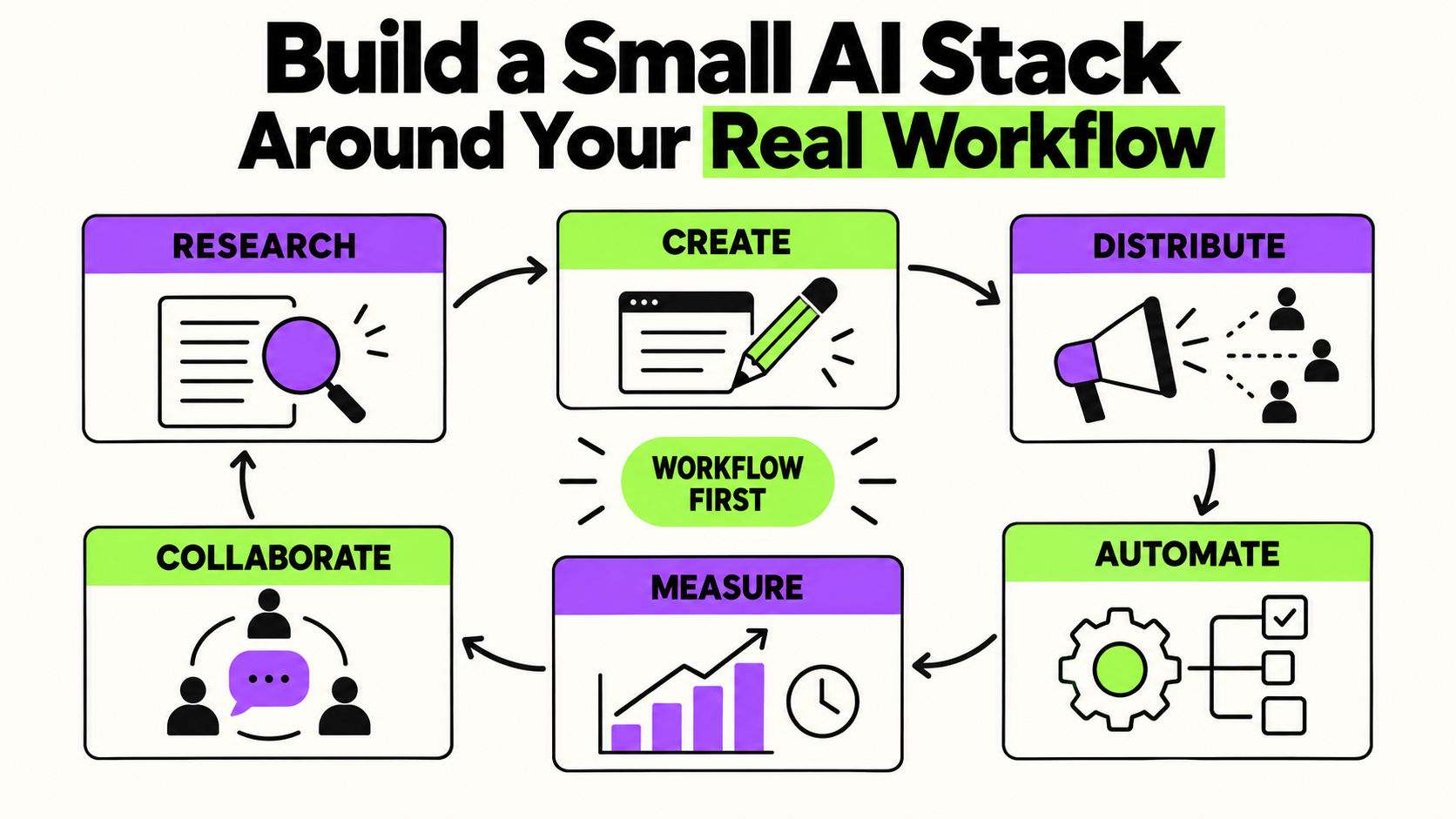
AI tool lists are easy to collect and hard to operate. A team signs up for an assistant, a research product, an image model, an automation platform, a meeting tool, and a no-code builder. Each looks useful in isolation. Together they create overlapping subscriptions, scattered context, unclear ownership, and another set of interfaces employees must remember.
A stack should be designed as a system of work, not a shelf of products.
Begin with repeated jobs
Map the work the team performs every week. Describe each job with a trigger, an input, a decision, an output, and a recipient.
“Create content” is too broad. “Turn a verified product update into a help-center note, customer email, and sales enablement summary” is specific enough to evaluate. The job reveals which context is required, where approval belongs, and what an accepted result looks like.
Prioritize jobs that are frequent, slow, structured enough to improve, and valuable enough to justify change. A rare task with dramatic demo potential may deliver less value than a routine process that quietly consumes ten hours every week.
Separate capabilities from products
Teams often buy several products that contain the same underlying capabilities. Build a capability map before selecting vendors.
Common layers include research and retrieval, reasoning and drafting, media generation, coding and building, workflow orchestration, knowledge storage, evaluation, and governance. One product may cover several layers; one layer may require specialist depth.
The map makes duplication visible. It also reduces dependency on brand-specific terminology that can change faster than the underlying job.
Evaluate the path to an accepted result
Raw generation speed is a weak metric. Measure the full path from request to accepted output.
An effective pilot should test:
- Quality against a pre-defined rubric.
- Time saved after review and correction.
- Error, hallucination, and rework rates.
- Ability to use the team’s real context.
- Integration with existing systems.
- Adoption by the people who perform the job.
- Data handling, access controls, and auditability.
- Total cost, including implementation and supervision.
A tool that produces an answer in seconds but requires twenty minutes of repair may be slower than the current process.
Make context portable
The most important asset in an AI stack is often not the model. It is the organization’s context: terminology, policies, product facts, customer research, examples, and decisions.
Avoid trapping that context inside personal chats or one vendor’s workspace. Establish approved sources, clear ownership, update rules, and export paths. Where possible, let multiple tools retrieve from the same maintained knowledge layer rather than creating separate copies.
Portable context makes it easier to change models and prevents conflicting versions of the truth.
Design handoffs before automation
Most useful workflows cross tools and people. Research becomes a brief; the brief becomes a draft; the draft becomes an asset; the asset moves through approval and distribution.
Document the handoffs before automating them. Define the data structure, validation, failure behavior, and person responsible at each transition. Otherwise the stack can move flawed work faster while making the source of the flaw harder to see.
Automation should expose status and exceptions. A silent chain of black boxes is difficult to trust.
Keep humans at consequential decisions
Not every step deserves the same level of oversight. Low-risk transformations—formatting, classification, summarization of approved material—can often run with light review. Public claims, financial decisions, customer commitments, access changes, and reputation-sensitive content require stronger controls.
Create risk tiers and connect them to permissions. The tool should not gain broader access merely because it can technically complete a task.
Budget for adoption, not just licenses
The true cost of a tool includes training, process redesign, prompt or workflow maintenance, integrations, security review, and the attention required to keep outputs reliable.
Assign an owner to every production tool. The owner tracks use, quality, incidents, cost, and changes in vendor behavior. A tool without an owner tends to become either shelfware or shadow infrastructure.
Adoption should be visible in completed jobs, not login counts.
Prune the stack on a schedule
AI products evolve quickly, and capability overlap grows. Review the stack quarterly.
For each tool, ask whether it still serves a distinct job, whether another tool now covers the capability, whether users have created workarounds, and whether the value exceeds the full operating cost. Consolidate when the loss in specialist quality is smaller than the gain in simplicity.
Keep an exit plan for important workflows: export formats, replacement options, and the minimum data needed to move.
What to do next
List the ten AI tools your team uses or is considering. Replace the product names with the recurring jobs they are meant to improve. Remove duplicates, select one measurable pilot, and define an accepted result before the trial begins.
The strongest stack is rarely the largest. It is the one the team can understand, govern, and use without rebuilding its work around the tools.