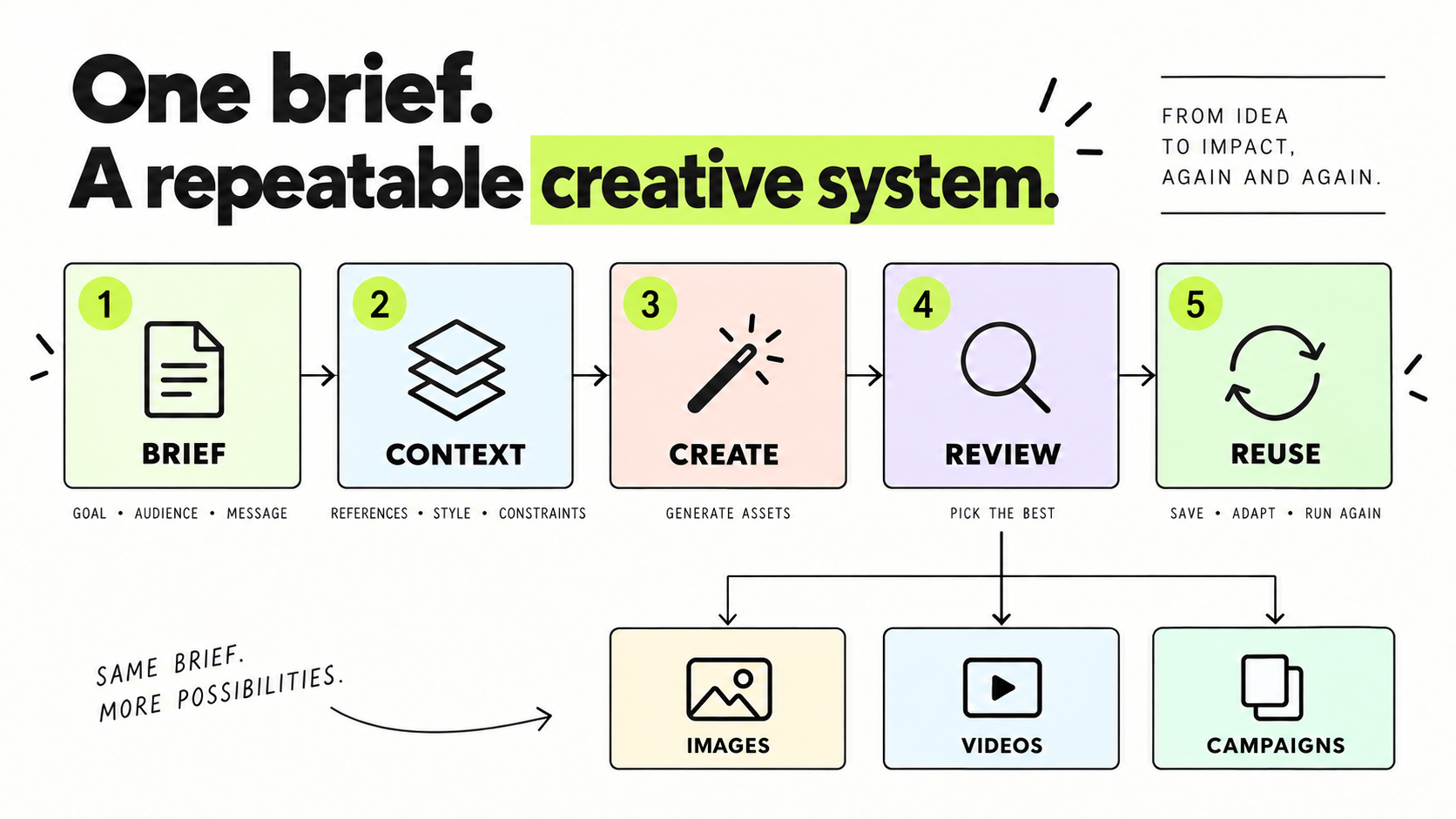
AI creative tools are often blamed for inconsistent output, but inconsistency usually begins before generation. A team opens a model, writes a fresh prompt, tweaks it until something looks acceptable, and repeats the entire process for the next asset. The model changes, the prompt changes, the reviewer changes, and the creative direction quietly changes with them.
The missing layer is not a longer prompt. It is a durable creative brief that separates strategic decisions from execution choices.
A prompt is an instruction, not a production system
A prompt can specify a scene, tone, camera angle, or format. It cannot automatically resolve who the work is for, what the audience should understand, which claims are defensible, how the asset fits a campaign, or what makes the result recognizably yours.
When those decisions remain implicit, every operator reconstructs them from memory. The workflow becomes fragile: good results depend on the person at the keyboard, and a successful experiment is difficult to reproduce.
A brief turns those hidden decisions into shared inputs. The prompt then becomes one replaceable component inside a larger system.
Build the brief in five layers
The most useful AI briefs are compact enough to reuse and specific enough to constrain the work.
- Audience context. Define the situation, level of awareness, objections, and language the audience already uses. “Marketing leaders” is too broad; “a small ecommerce team trying to produce weekly paid-social variants without an agency” is actionable.
- Communication goal. State the single idea the asset must make clear and the response it should produce. This prevents visual novelty from replacing the message.
- Evidence and boundaries. Include approved facts, product details, source material, prohibited claims, and areas that require verification.
- Creative direction. Provide references for mood, composition, pacing, materials, and brand behavior. References should communicate principles, not invite imitation.
- Output contract. Specify channel, aspect ratio, duration, resolution, accessibility needs, required variants, and review criteria.
Only after those layers are stable should the team choose a generation model and write the execution prompt.
Treat context as a reusable asset
The largest efficiency gain does not come from generating faster. It comes from avoiding repeated decisions.
Store the audience definition, approved positioning, evidence, visual principles, and channel requirements as a reusable context package. A campaign-specific brief can inherit that package and add only what changed. This creates consistency without forcing every asset into the same template.
Versioning matters. If the positioning changes, the context package should show what changed and when. Otherwise teams may continue generating assets from stale assumptions while believing they are following the latest strategy.
Design a production loop, not a one-shot prompt
A reliable creative workflow has distinct stages:
- Brief approval before generation begins.
- Exploration that produces meaningfully different directions, not cosmetic variations.
- Selection against the communication goal.
- Refinement for accuracy, composition, brand fit, and channel constraints.
- Human review before publication.
- Performance feedback that updates the next brief.
The feedback stage is easy to miss. Click-through rate, watch time, qualified responses, and sales conversations can reveal whether the brief was correct—not merely whether the rendering was attractive.
Scale variation without producing sameness
Automation can multiply a weak idea just as efficiently as a strong one. The system should lock the strategic core while allowing controlled variation in hooks, scenes, formats, and pacing.
Define which fields are fixed and which are variable. The core claim and evidence may be fixed. The opening visual, product angle, audience example, or duration may vary. This gives the model room to explore while keeping the campaign coherent.
It also makes testing interpretable. When every element changes at once, performance data cannot explain what worked.
Governance is part of creative quality
AI production needs named owners. Someone approves facts. Someone owns brand consistency. Someone decides whether an asset is ready to publish. High-risk claims require a different review path from decorative background imagery.
The goal is not to slow the workflow. It is to put attention where failure would matter. A lightweight risk tier can keep low-risk variants moving while requiring deeper review for regulated, comparative, or reputation-sensitive work.
What to do next
Take one recurring campaign and document the decisions your team currently recreates each time. Turn them into a one-page brief with the five layers above. Generate three distinct directions from the same approved context, review them against explicit criteria, and record what you learned.
If the second campaign is easier to produce—and easier for another person to operate—the brief is becoming infrastructure rather than paperwork.